
Criminal Court Records in Tunica County
A Tunica County criminal court record is the official case file the Circuit Clerk opens once a criminal charge is filed in court. It is not the same as an arrest record. The arrest side begins with the Sheriff and the jail booking, while the court record begins when the case reaches a judge. The file holds the charges as filed, the defendant's pleas, every motion and order, the hearing history, and the final judgment. Circuit Clerk Sharon G. Reynolds keeps these records and runs the office that serves as the administrative arm of the Circuit Court. Each filing, from the first appearance to the sentencing order, becomes part of the permanent case record.
Two court levels produce most criminal records in the county. Felony cases are tried in Circuit Court, the principal trial court for serious crimes, jury trials, and appeals from lower courts. Tunica County sits in the Eleventh Circuit Court District, which also covers Bolivar, Coahoma, and Quitman counties. Lower-level misdemeanors and ordinance violations are handled at the Justice Court and the Town of Tunica Municipal Court. Tickets written by the Sheriff or the Mississippi Highway Patrol route to Justice Court, while town police citations go to Municipal Court. The charges side of a case is covered in more depth in the Tunica County arrest records and court charges page.
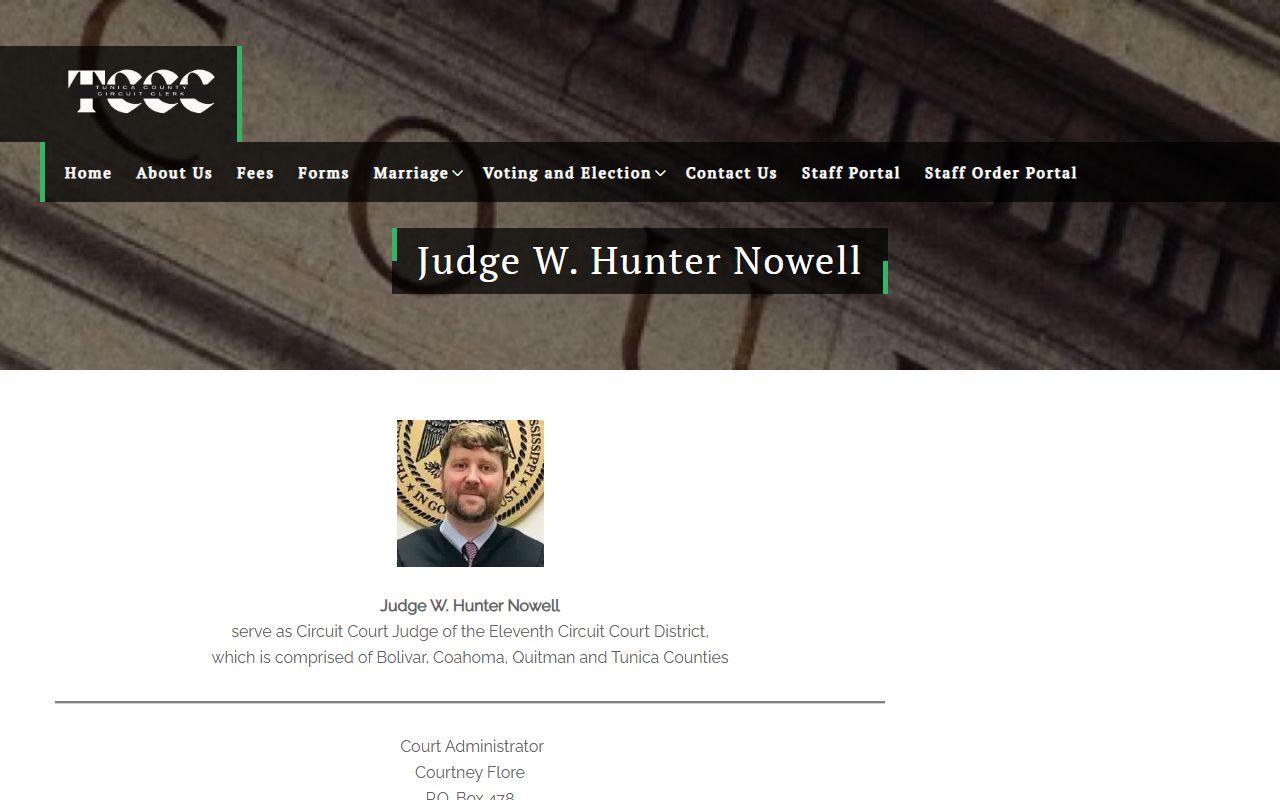
Three judges preside over felony matters across the Eleventh Circuit Court District. Senior Circuit Court Judge Charles E. Webster handles cases alongside Judge Linda F. Coleman and Judge W. Hunter Nowell. The county Circuit Clerk site publishes a contact page for the senior Circuit Court judge for the Eleventh District, which lists the court administrator who manages the docket.
The judge who signs the order on a case appears in the criminal court record, so the bench that hears Tunica County felonies is woven directly into the file you read.
How to Search Tunica County Criminal Court Records
The county does not run a single free criminal case database. Searching is split by court level, and the main statewide tool is Mississippi Electronic Courts, or MEC. The Mississippi Judiciary notes that Tunica County Circuit Court began voluntary attorney e-filing on November 25, 2024 and mandatory e-filing on December 2, 2024. MEC covers participating Circuit, Chancery, and County Courts, but detailed case access is tied to registration through the state portal. For records the order center does not reach, the Circuit Clerk offers a record search for a set fee and certified copies on request.
- Identify the court that heard the case. Felonies are in Circuit Court; minor misdemeanors are in Justice Court or Municipal Court.
- For Circuit Court files, use the Circuit Clerk online order center to request a record search by name or case number, or call 662-363-2842.
- Check whether the case is available through MEC, the state e-filing system, which may require account registration.
- Open the case to read the docket, charges, pleas, and the disposition that closed each count.
- Request a certified copy from the Circuit Clerk at 1300 School Street when a sealed, signed copy is needed for legal use.
Statewide criminal history is a separate matter from a single county case file. A person already sentenced to state prison appears in the Mississippi Department of Corrections inmate search rather than the local court docket. The hearing schedule that frames a Circuit Court case is set by the district judges, and the clerk's office can confirm which judge is assigned. The district judge contact page for Judge Linda F. Coleman lists the administrator and law clerk who keep that judge's calendar.
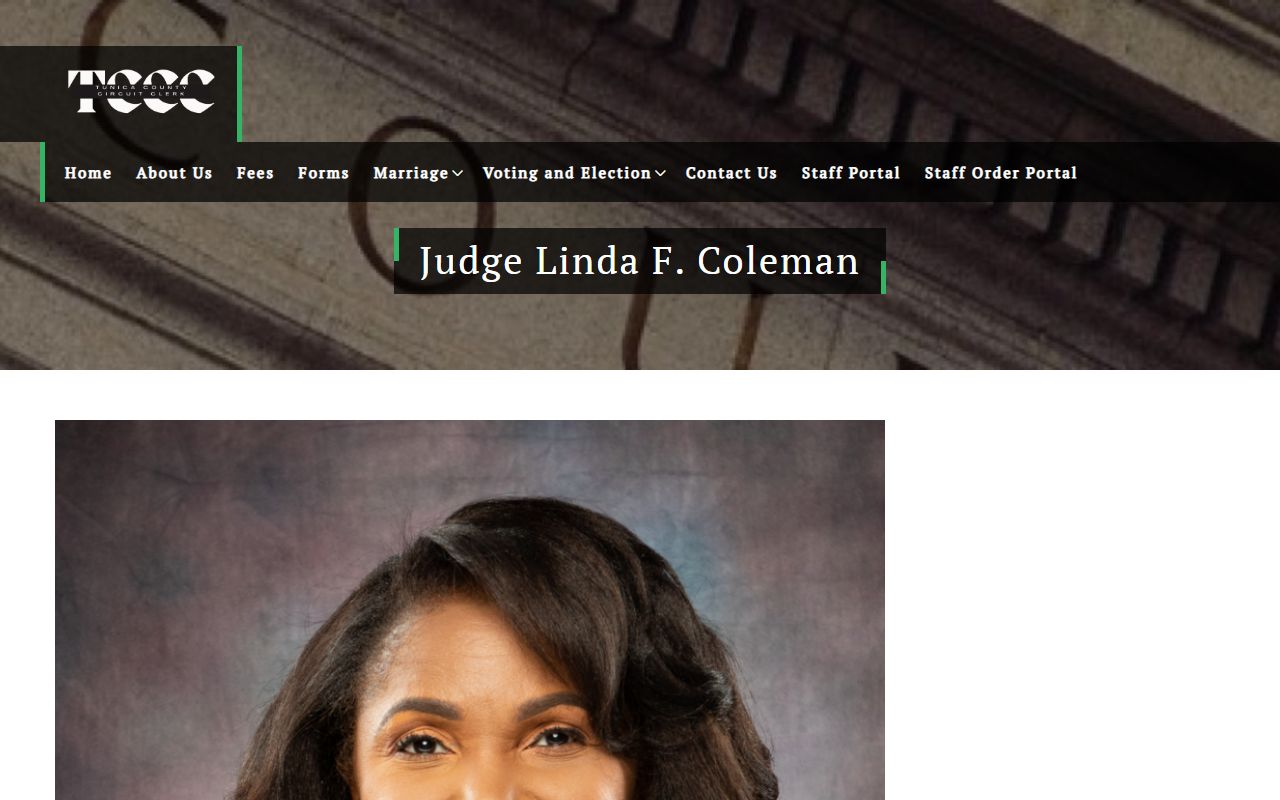
Knowing the assigned judge helps because hearing dates, continuances, and orders all post to the case under that judge's name.
Stages of a Tunica County Criminal Case
A criminal case moves through fixed stages, and each step leaves an entry in the court record. The file is read as a timeline. It starts with the charging document, runs through pretrial work, and ends with a disposition and a sentence if there is a conviction. In felony cases, a grand jury reviews the evidence before a formal indictment, so the court record may begin with an indictment rather than a simple complaint.
Case flow: Charges Filed › Arraignment › Pretrial / Motions › Plea or Trial › Disposition › Sentencing
| Stage | What Happens |
|---|---|
| Charges Filed | The prosecutor files a complaint, information, or grand-jury indictment that names the defendant and the counts. |
| Arraignment | The court reads the charges, advises the defendant of rights, and takes the first plea of guilty or not guilty. |
| Pretrial / Motions | Lawyers file motions, exchange evidence, set bond, and argue requests the judge rules on before trial. |
| Plea or Trial | The case ends in a guilty plea, or it goes to a jury or bench trial that returns a verdict. |
| Disposition | The court records the outcome of each count: conviction, dismissal, acquittal, or other resolution. |
| Sentencing | For a conviction, the judge orders the punishment, which may include prison, probation, fines, and restitution. |
The Circuit Clerk Forms page lists a Petition to Enter a Guilty Plea, which shows that plea paperwork is part of the local court-document set. When a defendant pleads guilty, that signed petition and the resulting judgment both land in the case file. Note: a case can sit in the pretrial stage for months, so an open file with no disposition does not mean the case ended.
What a Tunica County Criminal Court Record Shows
A criminal court file is built from many small fields, and each one tells part of the story. The record names the court and county, the parties, and the judge, then tracks every event in the docket. Criminal cases in Mississippi are styled as the State against the defendant. The file also carries financial fields such as fines, court costs, bond, and any restitution ordered.
| Field | What It Shows |
|---|---|
| Case Number | The official number the court assigns to the case; the local format was not published, so confirm it with the clerk. |
| Defendant | The person charged, listed as the defendant in a State of Mississippi prosecution. |
| Charges | The offense, the statute cited, the count, and the class or severity of the crime. |
| Plea | The defendant's formal answer: guilty, not guilty, or no contest. |
| Docket Entries | The dated list of filings, motions, orders, hearings, and trial settings. |
| Disposition | The outcome of each charge, such as conviction, dismissal, or acquittal. |
| Sentence | The punishment ordered, including prison, probation terms, fines, fees, and restitution. |
Some details are redacted even in an open file. Social Security numbers, financial account numbers, the names of minors, and sealed or expunged criminal history are removed or withheld. The documents themselves stay in the record too, including complaints, motions, orders, judgments, and the guilty-plea petition when one was filed.
The District Attorney and Grand Jury Role
Felony charges in Tunica County are handled by the Office of the District Attorney for the Eleventh Circuit Court District. District Attorney Brenda F. Mitchell prosecutes felony matters for Bolivar, Coahoma, Quitman, and Tunica counties. The office represents the State in all matters that come before the grand juries of the district. That grand-jury step is why a felony court record often opens with an indictment, the formal charging document a grand jury returns after reviewing the evidence.
The prosecutor's decisions shape what the court record shows. Charges can be amended, reduced, or dropped, and plea negotiations can change the counts that end up in the judgment. The Eleventh Circuit Court District Attorney office handles those filings and announcements for the four-county district.
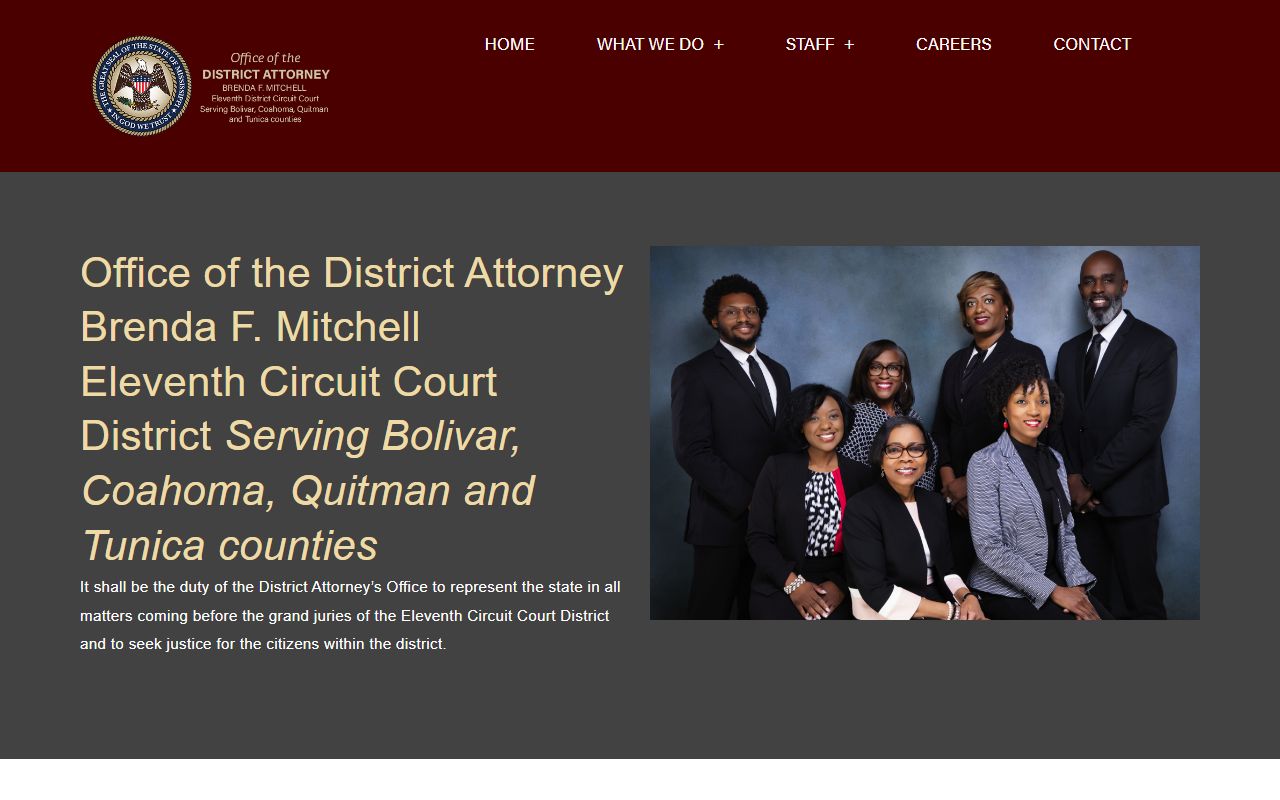
Because the arrest charges and the filed court charges can differ, the case file from the Circuit Clerk, not the jail booking sheet, is the document that shows the charges the State actually pursued.
Defendants who cannot afford a lawyer are represented by appointed counsel. Mississippi keeps a statewide directory rather than a single Tunica office page. The state Office of State Public Defender explains that the directory is maintained by the Division of Public Defender Training. The Mississippi public defender directory is the place to confirm appointed-counsel contacts.
The lawyer of record for each side appears in the case file, so the directory helps a reader match the names that show up on the docket.
Charges vs. Convictions
Being charged is not the same as being convicted. A criminal court record can list charges that were later dropped, dismissed, or that ended in an acquittal. A charge is an accusation that only needs probable cause to be filed. A conviction is a finding of guilt, and it requires proof beyond a reasonable doubt or a guilty plea. Reading the disposition for each count is the only way to tell which charges led to a conviction.
| Charge | Conviction | |
|---|---|---|
| Stage | Accusation | Verdict or guilty plea |
| Burden of Proof | Probable cause | Beyond a reasonable doubt |
| Filed By | Prosecutor or grand jury | Decided by judge or jury |
| Public Record | Yes | Yes |
This distinction matters for anyone reading a record about another person. A long list of counts at the top of a file can shrink to a single conviction by the end. Treat the charges as the starting point and the disposition as the result.
Reading Dispositions and Sentences
The disposition is the outcome the court records for each charge. Common entries include guilty, not guilty, dismissed, and nolo contendere, which means the defendant does not contest the charge. A guilty plea or a guilty verdict produces a conviction and a sentence. A dismissal or an acquittal ends the count without one. The sentence then spells out the punishment, and it can mix several parts.
A sentence may combine prison time, probation, fines, court costs, and restitution to a victim. Probation is supervised release used instead of or after time in custody. The judgment lists how long each term runs and any conditions attached. The district judge contact page for Judge W. Hunter Nowell is one of three Eleventh Circuit judges whose signed orders set these terms in Tunica County cases.
The sentencing order is the entry that carries the most weight in a criminal court record, since it states the final result of the case.
Some terms in a sentence point to further records. A capias is a warrant-like process that commands arrest, often after a failure to appear, and it can show up when a defendant misses a court date. Active warrants tied to a case are tracked through the Tunica County warrant records channels rather than the closed case file.
Sealed vs. Expunged Records
Not every criminal record stays open forever. Mississippi law lets some records be sealed or expunged, and the two are not the same. A sealed record stays in the court system but is closed from public view by statute or court order. An expunged record is treated as if it never existed, and a public search should not return its details.
| Sealed | Expunged | |
|---|---|---|
| Visibility | Hidden from public view | Removed and treated as never existing |
| Law Enforcement | Limited access | Very limited access |
| Mississippi Basis | Court order or statute, such as youth and adoption confidentiality | Petition under Miss. Code Section 99-19-71 |
Expunction is filed in the court that handled the arrest, charge, or conviction, which can be the justice, county, circuit, or municipal court. Section 99-19-71 is the governing statute, and Section 99-19-72 sets a $150 filing fee for the petition. Once an order is entered, the case is no longer a standard public lookup result. The Circuit Clerk cannot give legal advice, so a person seeking expunction should speak with an attorney about eligibility.
Public Access to Criminal Court Records
Most adult criminal court files in Tunica County are public. The Mississippi Public Records Act supports access to records held by public bodies, although some judicial records follow separate court rules, e-filing access, and clerk procedures. The practical path is to start with the clerk for the court that heard the case. Circuit Court criminal files go through the Circuit Clerk, while Justice Court and Municipal Court hold their own lower-level matters. Fees may apply, including a record search fee and a per-page copy charge at the Circuit Clerk.
Key Statutes:
Mississippi Public Records Act, Miss. Code Title 25, Chapter 61 - makes records of public bodies generally open for inspection unless an exemption applies.
Mississippi Code § 99-19-71 - lets qualifying criminal records be expunged by petition under the listed circumstances.
Mississippi Code § 43-21-251 - keeps youth court records confidential and limits who may see them.
For matters that are juvenile, adoption-related, sealed, or expunged, access is denied or limited to authorized parties, attorneys, or people with a court order. The full set of court records and the channels for each court level are covered on the Tunica County court records page.
Background Check Considerations
A casual record lookup is not the same as a formal background check. A criminal court file shows what happened in one case, but a true background screen pulls from many sources and follows federal rules. Employers, landlords, and lenders who rely on a screening must use a service that complies with the Fair Credit Reporting Act. A single county docket entry can be incomplete, out of date, or missing a later disposition.
Important: This site is not a consumer reporting agency under the Fair Credit Reporting Act, and its information cannot be used for employment, credit, housing, or other FCRA-regulated decisions.
Restricted Criminal Court Records in Tunica County
Some criminal court records are kept out of public view. Youth Court handles juvenile cases, and Mississippi Code Sections 43-21-251 and 43-21-261 make those records confidential, with access limited to parents, guardians, attorneys, and others the statute names. Adoption files are confidential under Section 93-17-25 and open only by court order on good cause. Sealed cases and expunged cases also fall outside a normal search.
Ongoing matters carry their own limits. A case still under investigation, a sealed indictment before arrest, or a record with protected victim and witness details may be withheld or redacted. Mental-health and civil-commitment files are treated as restricted as well. When a record is not available online, the next step is the clerk for the court that handled it, who can explain what is releasable and what a certified copy costs.