
Tunica County Arrest Records and Court Charges
A Tunica County arrest record is the law-enforcement account of a person being taken into custody. It names the arresting agency, the booking date and time, and the alleged charges entered at intake. In most local cases the arresting agency is the Tunica County Sheriff's Office, led by Sheriff K.C. Hamp, and the booking happens at the Tunica County Detention Center on Old Mhoon Landing Road. An arrest by itself does not open a court case. After the arrest, a prosecutor reviews the facts and decides the formal charges. Those charges are then filed with the court clerk, and that filing becomes the court charge record.
The two records live in different places. The arrest and booking side sits with the Sheriff, and the jail roster is the fastest way to see who is in custody and what they were booked on. For that booking detail, see the Tunica County inmate records page and the Detention Center roster. The court charges after arrest are a separate file. They track what the prosecutor actually filed, how each count is worded, and how it changes as the case moves. The full case file, pleas, and final outcome live on the criminal court records page.
The Sheriff's Office publishes its mission, contact lines, and record tools on the agency home page. You can reach the Tunica County Sheriff's Office site to confirm the 24-hour phone, the crime-tip hotline, and the links to its roster and most-wanted pages.
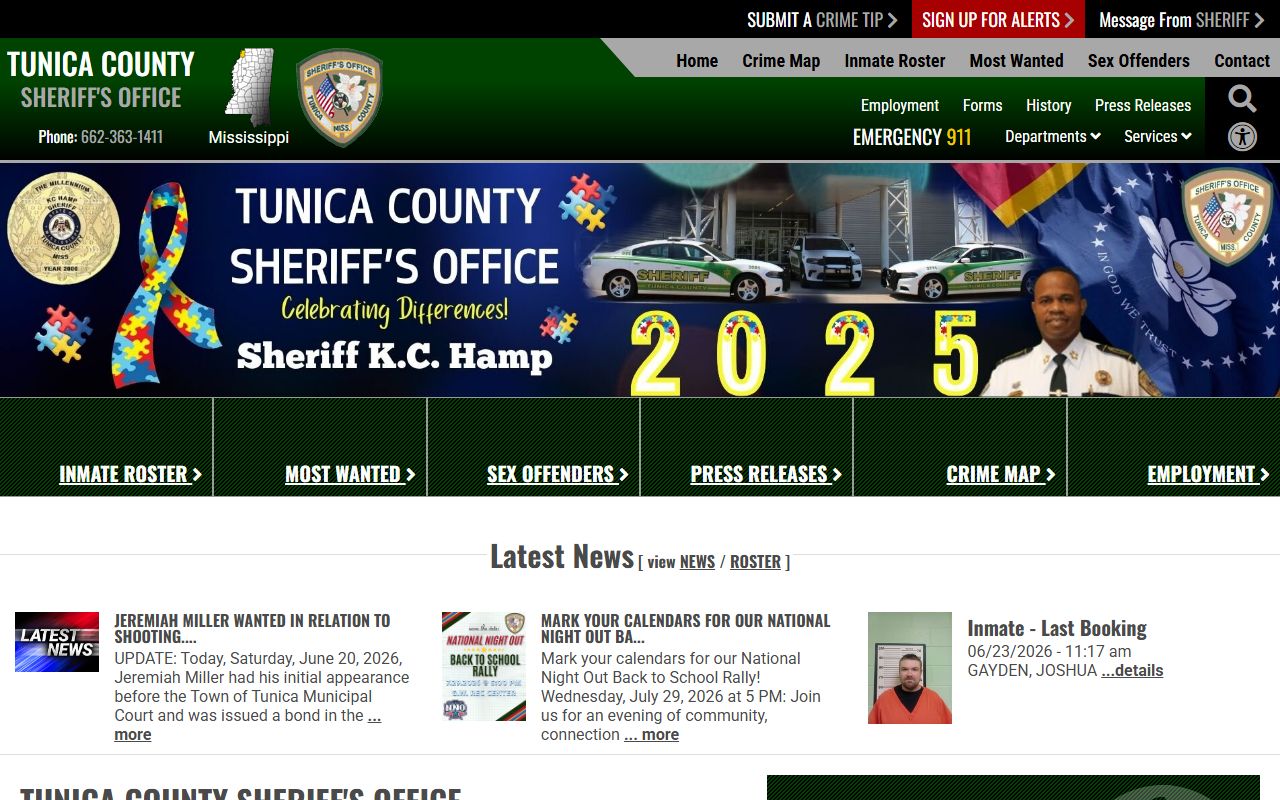
That home page is the entry point for the arrest side of the record, while the charges filed afterward are searched through the court clerk and the statewide court system described below.
How to Find Tunica County Arrest Records and Charges
There is no single button that returns both an arrest record and the filed charges. The booking side comes from the Sheriff's roster, and the charge side comes from the court that handles the case. Felony charges in Tunica County are filed in Circuit Court and indexed by the Circuit Clerk, Sharon G. Reynolds, at the courthouse on School Street. Many misdemeanor and traffic charges route to Justice Court or to the Town of Tunica Municipal Court instead, depending on the agency that made the arrest. Start with the court that matches the offense level.
The Circuit Clerk does not post a full free case-search screen, but the office runs an online order center with a record-search service and copy requests, and the statewide Mississippi Electronic Courts (MEC) system now covers Tunica Circuit Court filings. To trace charges from an arrest forward, work the case index this way:
- Identify the court by offense level: Circuit Court for felonies, Justice or Municipal Court for misdemeanors and tickets.
- Search the clerk's index or the MEC system by the defendant's name or by the case number.
- Open the case and read the charge list as the prosecutor filed it.
- Check each charge for its statute code, severity level, and current status.
For booking-level detail, the Detention Center roster is searchable by name and sortable by date. The roster landing page lets you choose current inmates or the 48-hour release list before you open a profile.
You can browse the live booking list directly through the Tunica County inmate roster, which lists each person's name, booking number, booking date, charges, and bond.
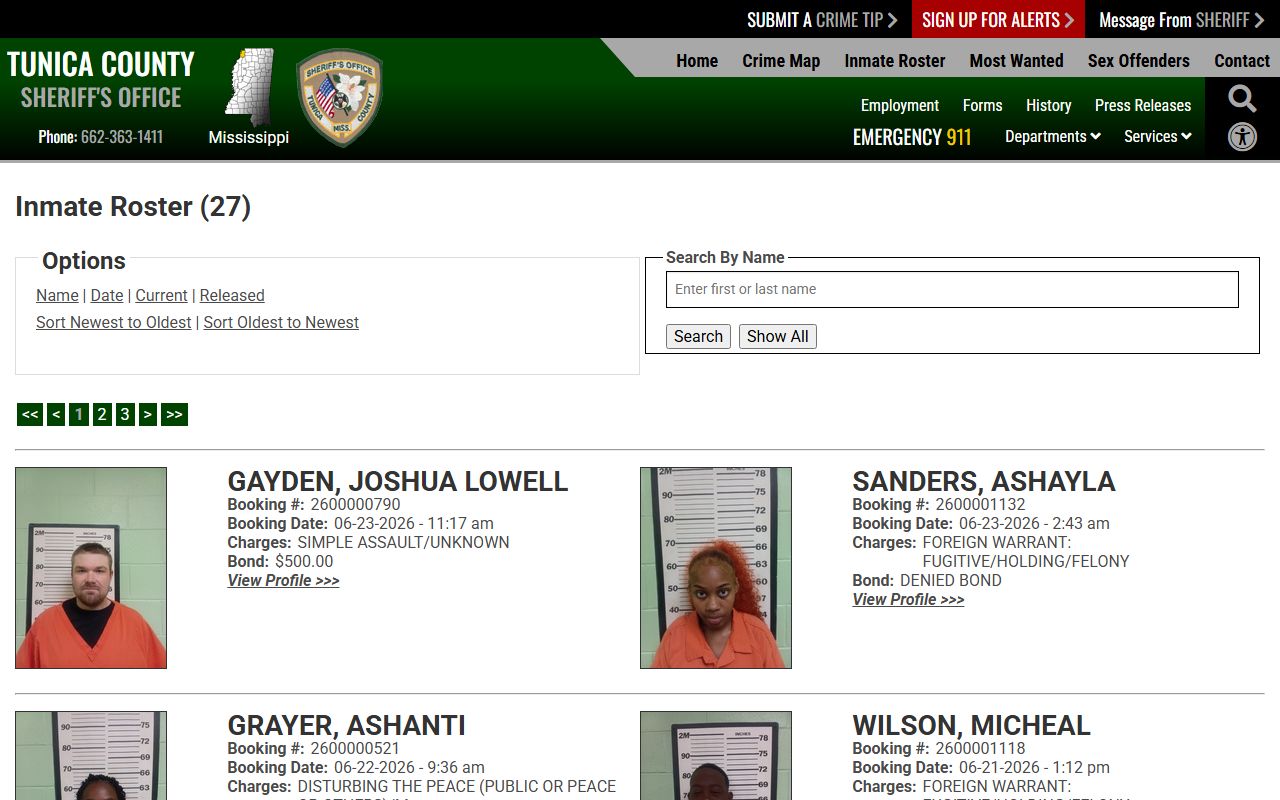
The roster shows the charges logged at arrest, but those entries can shift once a prosecutor files the formal charges and a judge sets bail.
How Charges Get Filed After an Arrest
The path from arrest to court charge runs through a charging document. The arrest and booking come first. The charge record begins when a prosecutor or grand jury files a formal accusation with the court. In the Eleventh Circuit Court District, which covers Tunica along with Bolivar, Coahoma, and Quitman counties, felony prosecutions are handled by District Attorney Brenda F. Mitchell. The DA's office represents the State in matters that come before the district's grand juries, and a grand jury indictment is the charging document for serious felonies. Lower-level cases start with a complaint or an information instead.
Three charging documents do most of the work in Mississippi, and each one opens the case in a slightly different way.
| Complaint | Information | Indictment | |
|---|---|---|---|
| Filed By | Officer / Prosecutor | Prosecutor | Grand Jury |
| Common For | Misdemeanors | Many felonies | Serious felonies |
| Starts | The case | The case | The case |
An arrest that looks simple on the roster can produce more than one charging document if some counts are misdemeanors and others are felonies routed to the grand jury. That is one reason the booking charges and the filed charges do not always match line for line.
Charge Status and What It Means
Charges rarely stay frozen. As a case moves, a charge can be amended, reduced to a lesser offense, added, dropped, or dismissed entirely. The court record tracks each change, so the status you see today may differ from the charge logged at arrest. The Detention Center roster makes the same point in plain terms: its profiles warn that charges and bail amounts can change after court appearances and may not be current. The terms below show up most often in a Tunica County charge record.
| Status | What It Means |
|---|---|
| Pending | The charge is filed and the case is active. No plea or verdict has been entered yet. |
| Amended / Reduced | The prosecutor changed the charge, often to a lesser offense, before trial or as part of a plea. |
| Dismissed | The court dropped the charge, so it does not move on to trial or sentencing. |
| Nolle Prosequi | A Latin term meaning the prosecutor has chosen not to pursue the charge any further. |
A single profile from the roster shows how arrest charges look before any of these changes are entered.
One sample inmate profile lists the booking number, the arresting agency, the booking and release dates, several misdemeanor counts, and a bond amount.
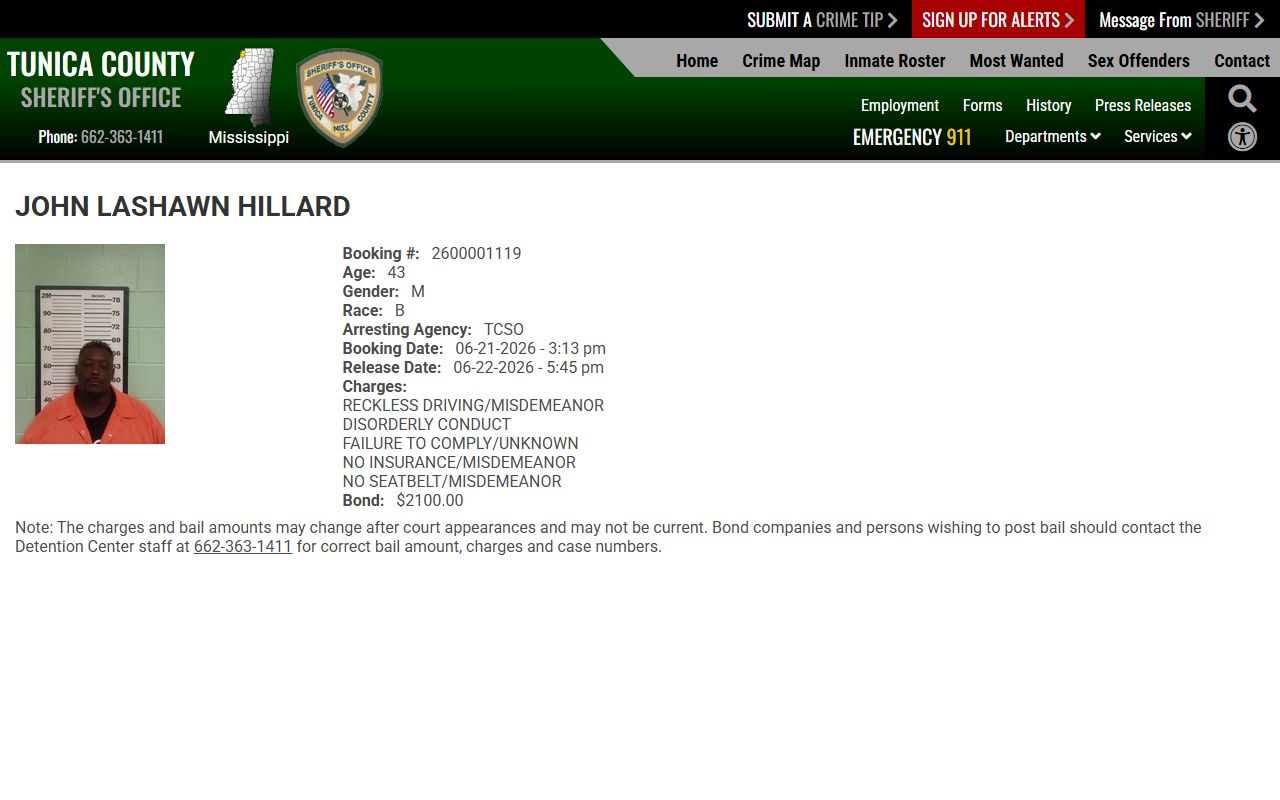
Those booking charges set the starting point, but the prosecutor's filing and the court's later orders are what control the final charge status.
Note: The roster tells bond companies and anyone posting bail to call the Detention Center at 662-363-1411 for the correct bail amount, charges, and case numbers.
Charges vs. Convictions
A charge is an accusation, not a finding of guilt. Being charged means a prosecutor decided there was enough cause to bring the case. A conviction is a separate result that only comes from a guilty plea or a verdict. Many charges in a Tunica County record are reduced, dismissed, or resolved without a conviction, so reading a charge as a conviction is a common and serious mistake.
| Charge | Conviction | |
|---|---|---|
| Stage | Accusation | Verdict or plea |
| Burden of Proof | Probable cause | Beyond reasonable doubt |
| Public Record | Yes | Yes |
Both the charge and the conviction are part of the public court file. The disposition line is what tells you which one you are looking at, and the full disposition and sentence are detailed on the Tunica County criminal court records page.
Sealed vs. Expunged Records
Some Tunica County charge records are kept out of public view. A sealed record still exists inside the court system but is closed to ordinary searches. An expunged record is treated as if it never happened and is removed from the standard public file. Mississippi law sets who qualifies for each, and the rules are narrow.
| Sealed | Expunged | |
|---|---|---|
| Visibility | Hidden from public | Destroyed / treated as never existed |
| Law Enforcement | Limited access | Very limited |
| Eligibility | Set by statute or court order, including youth and protected records | Qualifying records under Miss. Code 99-19-71 |
To expunge a qualifying record, a person files a petition in the court that handled the case and cites Mississippi Code Section 99-19-71. A separate statute, Section 99-19-72, sets a $150 filing fee for that petition. Once the order is entered, the charge no longer appears as a standard public lookup result.
Charge Codes and Severity Levels
Every charge in a court record is tied to a Mississippi statute. The code on the record points to the exact section of law the prosecutor says was broken, and that code also sets the severity level. Mississippi sorts offenses into felonies and misdemeanors, with traffic infractions and ordinance violations handled at the lower courts. A felony carries the possibility of state prison time, while a misdemeanor is punished by jail, fines, or both.
One arrest can create several separate charges, each with its own code and level. A roster sample from the Detention Center, for example, can list reckless driving, disorderly conduct, no insurance, and a seatbelt count all from the same booking. The court then handles each count on its own track, and the severity level decides which court hears it and how the case proceeds.
The Detention Center itself is run as a corrections operation with its own classification and intake structure under the Sheriff's Office.
The Sheriff's corrections page describes the Detention Center mission and names the Chief of Corrections and the Warden who oversee booking and custody.
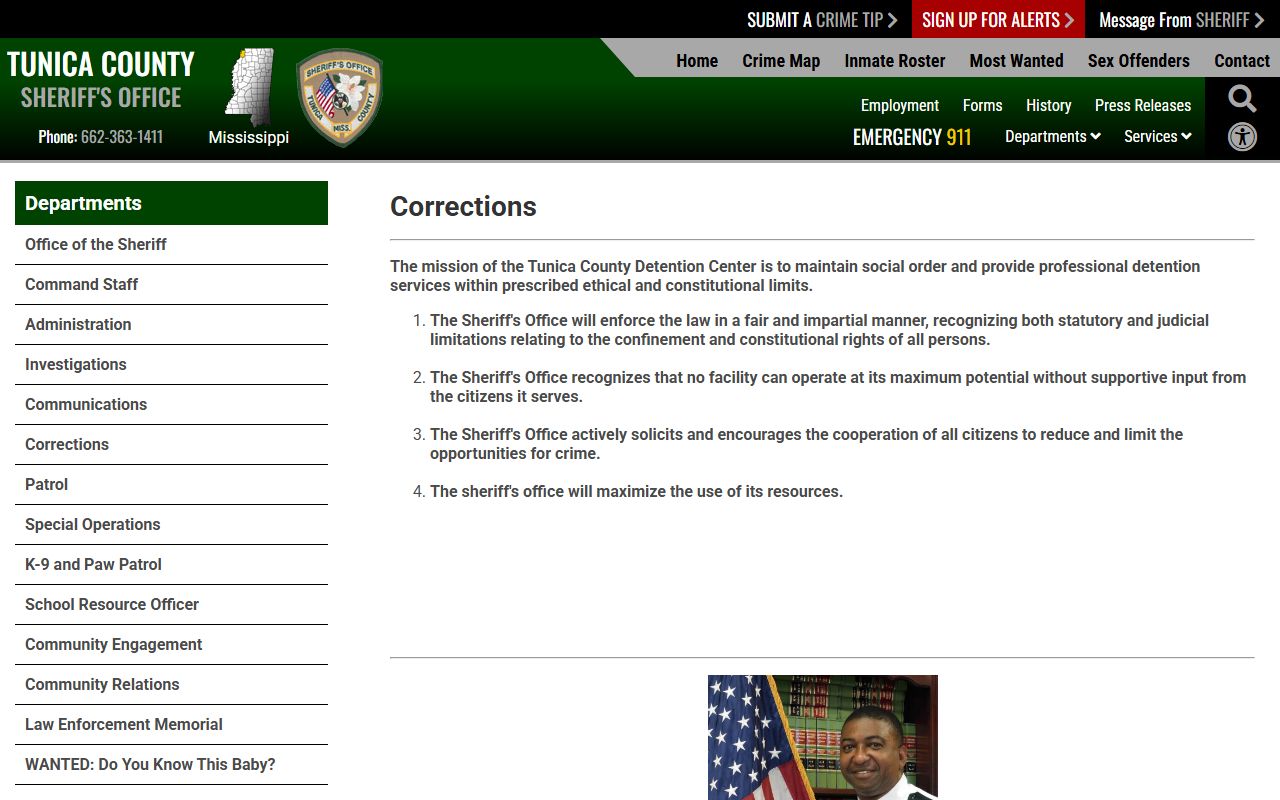
The codes logged at this stage feed the charge record, but the statute citations are finalized when the prosecutor files the charging document with the court.
Statewide Charge and Criminal History Lookups
Local charge records cover one county and one court. A person's full criminal history can reach across the state, so some charges roll up into statewide systems. Mississippi's court filings flow through the Mississippi Electronic Courts (MEC) system, which covers Circuit, Chancery, and County Courts. Tunica County Circuit Court joined MEC e-filing in late 2024, with voluntary attorney filing starting November 25, 2024 and mandatory filing on December 2, 2024. Account access and registration may be required for case detail.
For people who are sentenced to state prison rather than held in the county jail, the Mississippi Department of Corrections keeps a separate inmate search by name or MDOC number. Court-record access in Mississippi is shaped by the Public Records Act in Title 25, Chapter 61, and by court rules, so some filings are open while others are limited. The Mississippi Public Records Act page lists the governing sections, including the rules on fees and on denials.
Background Check Considerations
Reading a charge record for personal knowledge is different from running a formal background check. A casual lookup tells you what was filed and where the case stands. A background check used for hiring, housing, credit, or insurance is regulated by the federal Fair Credit Reporting Act and must come from a compliant consumer reporting agency. A raw charge record can be incomplete or out of date, and a charge that was later dismissed or expunged should not be treated as a conviction.
The biography of the elected Sheriff helps confirm which agency stands behind the local arrest and booking records you are reading.
The Office of the Sheriff page profiles Sheriff K.C. Hamp and his decades of service leading the agency that handles most arrests in the county.
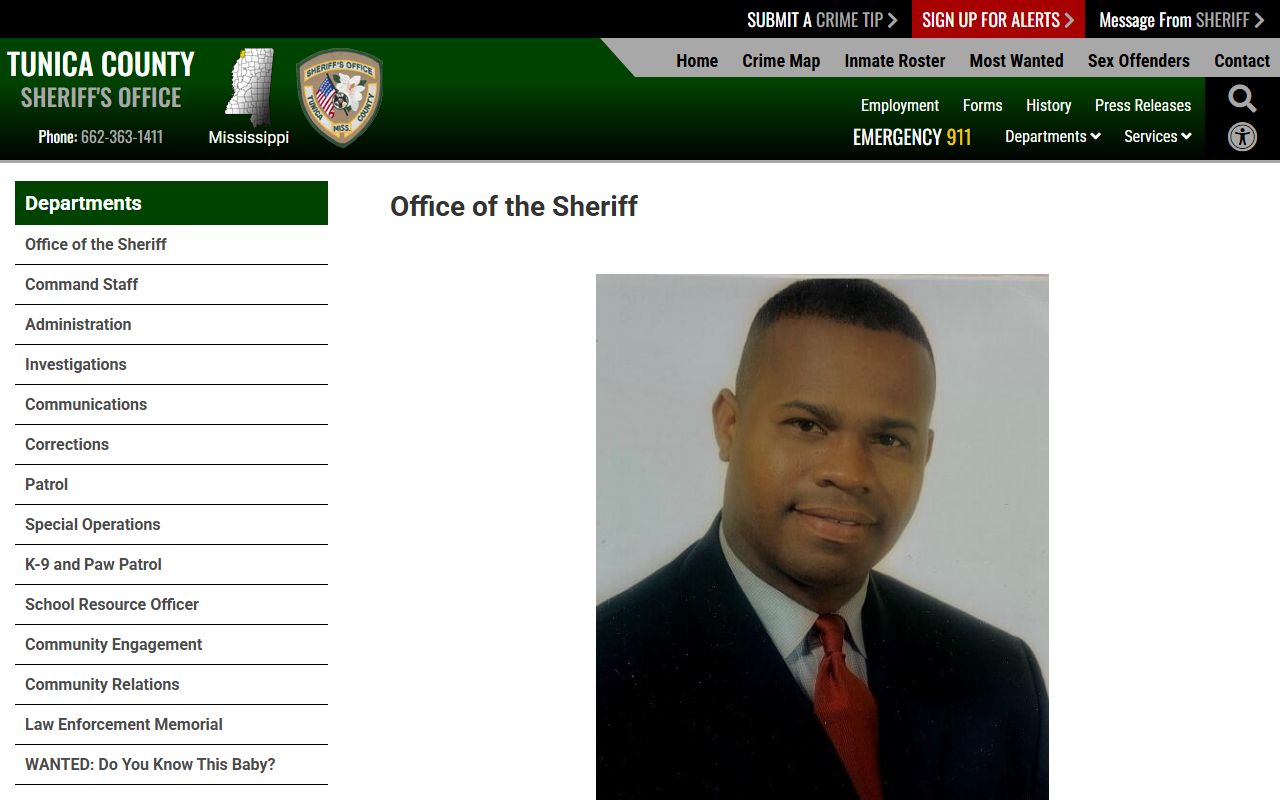
That office produces the arrest side of the record, while charge and disposition data should always be confirmed against the court file before it is relied on.
Important: This website is not a consumer reporting agency under the Fair Credit Reporting Act, and its data may not be used for employment, tenant, credit, or insurance screening.
Restricted Charge Records in Tunica County
Not every charge is open to the public. Mississippi law closes certain records to keep sensitive matters and minors protected. Youth Court charges are confidential under Sections 43-21-251 and 43-21-261 and are not part of an ordinary public search. Sealed charges, expunged charges, and records tied to ongoing investigations may also be withheld, and adoption-related and some mental-health matters are restricted by statute.
When a record is restricted, public staff may not confirm details, and access can be limited to the parties, their attorneys, or someone holding a court order. If a charge you expect to find is missing, it may be sealed, expunged, or filed in a court you have not checked yet. The Circuit Clerk and the Sheriff's Office cannot give legal advice, so a question about your own charge status is best handled by an attorney or by the clerk of the court that holds the case.
For active warrant questions tied to a charge, the Tunica County warrant records page explains which court or agency to call before the matter is resolved.